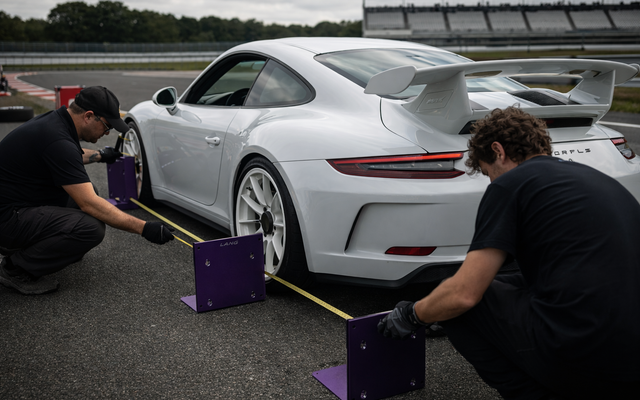
Inside the demanding world of modern pro-level oversteer competition, success is no longer exclusively a function of sheer horsepower or behind-the-wheel bravado. Conversely, it has become a multifaceted science that requires a scrupulous fusion of choosing a inherently capable car, arming it with the most precise drift-spec hardware, and, most critically, grasping its live characteristics on the circuit through sophisticated suspension tuning applications. This comprehensive manual will serve as your blueprint from the initial concept of a project car right through to the final engineering-refined refinements that turn a strong car into a predictable winner. We will delve deep into the art and science of car suspension tuning, demonstrating how a modern vehicle dynamics tool like GripDial eradicates guesswork and delivers unmatched insight into your car's real-world dynamics.
The foundation of any exceptional competitive sliding vehicle is, without question, the chassis itself. A select group of cars have attained renowned reputation within the international oversteer scene due to their built-in weight distribution, robust design, and the enormous availability of aftermarket support available. Selecting the right starting point is the primary and most important selection a enthusiast will make. To illustrate, the BMW's E36 3 Series is universally acknowledged as one of the best overall drift cars of the modern era. Its excellent 50/50 weight distribution, combined with a RWD configuration and extremely reliable inline-six engines, creates a car that is both easy to handle for novices and extremely capable in the control of a expert driver. The next step of this philosophy, the E46 model BMW, refines these strengths with a even more developed chassis, wider track for greater stability, and even more lock directly from the manufacturer. A distinct dominant option in the professional arena is the C6 generation Corvette.
This V8-powered performance car introduces a unique combination of strengths to the sideways sport, including a light alloy chassis, a rear-mounted gearbox and differential unit that contributes to an ideal balance, and the colossal low-end power of a large-displacement LS V8 motor. This combination renders it an absolute monster on track, able of starting and maintaining extended slides with seemingly easy application of power. For those seeking outstanding value, the 350Z model Nissan stands out as a top-tier candidate. It comes from the factory with a stiff body structure, a effective OEM limited-slip differential, and the free-revving V6 motor that provides ample horsepower and torque for learning and moving up in the activity. Its follow-up, the 370Z model, brings further refinements in chassis stiffness, suspension design, and outright motor output, establishing its status as a favorite choice among professional pilots. Other legendary cars that warrant attention include the nimble unique Mazda FC, the ubiquitous Nissan S13 240SX, the American Ford Mustang SN95, the modern BMW E90, and the compact yet incredibly engaging and instructive Mazda Miata. Every single one of these platforms gives a distinct set of traits, challenges, and capabilities, but they all share the basic ingredients required to be transformed into a competitive drift machine.
However, selecting the correct car is just the first step. To access the true potential of every of these machines, major upgrades to the steering geometry and chassis control systems are completely mandatory. This is where the domain of specialist drift-spec components enters vital importance. The single most transformative improvement for a purpose-built competition vehicle is the integration of a drift-spec drift angle kit. These engineered systems, like those manufactured by performance brands like SLR, are designed to dramatically increase the car's available steering angle. A standard street car is severely limited in how far its front wheels can rotate, a design limitation for on-road use. In drifting, but, extreme steering input is continuously necessary to control and hold a angle. An angle kit substitutes the stock hubs, tie rods, and sometimes suspension arms with pieces that allow the front tires to reach steering lock in excess of 70 or even 80 degrees, compared to a typical stock limit of around 40 to 50 °.
This vastly increased steering angle provides the operator with dramatically enhanced control during a angle, enabling it to be considerably more straightforward to start a slide, sustain it through a long corner, and change seamlessly from one direction to another. The improvement in controllability is truly profound. Coupled with a properly specified modification is the equally critical enhancement to the chassis's spring and damper setup. Store-bought or even premium sport coilovers are generally not designed for the unique and extreme requirements of competitive oversteer. A purpose-built system of adjustable dampers is paramount. These specialized dampers incorporate unique damping rates and spring rates that are designed for the rapid mass transition that is characteristic of aggressive driving. When a pilot initiates a slide, the car's inertia is transferred forcefully to the outside of the turn. Proper performance suspension control this shift in a predictable way, enabling the car to settle promptly and offering the pilot accurate response through the controls and cockpit. They also enable precise adjustment of ground clearance, shock absorber stiffness, and cross-weight, which are all integral elements of fine-tuning the chassis's dynamics to a particular circuit or driving style. As a system, a top-tier drift angle kit and a correctly chosen set of drift-spec coilovers are the undeniable hardware foundation upon which all future tuning is constructed.
Once the core components is installed, the subsequent essential phase in the build is the meticulous adjustment of the car's alignment. This is the realm of chassis dynamics adjustment, a methodology that can appear intimidating to the uninitiated but is, in reality, the secret to turning a assembly of high-performance pieces into a cohesive and predictable whole. The most discussed parameter of tuning for drifting is definitely camber angle. Camber is the inclination of the tire relative to the perfectly straight axis when viewed from the front-on of the chassis. If the top of the wheel is angled inward, this is known as camber-in. In drifting, inward-leaning wheels on the steering wheels is universally applied and is regarded as necessary. The logic is intrinsically related to physics.
When a chassis is turning at extreme angles, the chassis rolls to the outer of the turn. This body roll causes the outer steering tire to lose its ideal grip area with the tarmac. By adding inward lean, the tire is pre-angled to account for this roll. As the vehicle tilts into the corner, the tire becomes more upright with the track, optimizing its grip at the critical point when it is most required for directional command. Typically, front adjustments for a serious drift car vary from approximately -3 degrees to as extreme as -5 degrees or even greater, contingent on the parameters of the vehicle geometry, compound type, and operator preference. The rear axle tires also use inward tilt, but the values are generally less and subtler than the front axle. Too much negative camber at the back can make the car excessively prone to oversteer and challenging to predict on power use, as it reduces the available grip area of the driven wheels during forward power delivery. Hence, rear axle camber settings are commonly in the vicinity of -1 degree to -3 degrees, achieving a precise equilibrium between giving enough side bite to assist in starting and sustaining the slide while simultaneously maintaining usable grip for power-down the bend. camber angle is only one part of the broader suspension geometry picture, which also includes toe, caster angle, and steer correction modification.
Toe refers to the angle of the tires when looked at from a bird's-eye view. Toe-in means the front edges of the tires are nearer together than the rear edges, while toe-out means the reverse. For oversteer, a small amount of front toe-out is frequently used to sharpen the initial handling response, making the car feel more responsive and eager to start a slide. Rear toe setting is generally set to zero or a very minute amount of toe-in to encourage predictability under throttle. Caster is the forward or aft tilt of the kingpin axis when observed from the side of the car. Increased caster angle improves self-centering and high-speed confidence, and it also increases camber gain during turning, which is highly advantageous. Setting these settings is a complex interaction where a adjustment to one setting can and often will affect the other settings. The old-school approach for dialing in a chassis's alignment for drifting has for a long time been a time-consuming endeavor of trial and error. A pilot or engineering group would apply a modification based on a hunch, run the car on track, use the pilot's individual feel and feedback, and then apply a further tweak. This process would iterate over and over until the car felt "good" or the available testing session was exhausted. This approach is not only incredibly slow in terms of hours and costs, but it is furthermore inherently inaccurate.
Pilot perception is a notoriously unreliable measurement tool, colored by numerous factors such as fatigue, varying track conditions, weather, and just the mood of the driver on that given run. What feels "tail-happy" on one pass might feel "pushing" on the next run, causing confusing information and counterproductive adjustments. This long-standing challenge in car suspension tuning is exactly where modern engineering tools has made its mark to transform the process.
The rise and application of advanced drift telemetry software has ushered in a radically different era for tuning and optimizing competitive drift machines. This new generation of tools, represented by innovative solutions like data acquisition tools, operate by directly measuring the live mechanical behavior of the car as it is piloted on the track. Unlike using subjective feel, these systems gather measurable metrics on essential parameters such as damper compression and extension, wheel speed, G-force loading, lock position, and accelerator and brake pedal position. This raw data stream is then analyzed by sophisticated algorithms that can visualize and interpret the information in a clear format. For the very first time, engineers and builders can observe exactly what the chassis is exhibiting at every point of a drift. This function transforms the complete alignment optimization procedure. Think about the specific goal of setting the front camber for a given chassis. Rather than applying a change from -3 degrees to -3.5 degrees and then running multiple runs to try and "feel" a change, a suspension tuning tool can deliver real-time and definitive feedback. The software can indicate visually how the wheel's loading is acting during the key stages of a slide: turn-in, sustain, and changing direction. It can demonstrate if the current angle is allowing the loaded tire to keep maximum contact or if the tire is over-stressed on its external shoulder.
The tool can subsequently suggest fact-based suggestions for modification. Perhaps the information shows that the outside front tire is even overworking its edge at -3.5 degrees of camber, implying that a move towards angle, say -4 degrees, might be warranted. Alternatively, the data might show that the tire is failing to coming up to heat or that the inside shoulder is wearing unevenly, which could point to that there is overly aggressive angle and a small reduction back to -3.2 degrees would be more ideal. This level of accuracy and actionable analysis was literally unimaginable in the days of pure mechanical setup.
The benefit of utilizing a comprehensive suspension tuning tool reaches far beyond drift suspension tuning guide only setting alignment. It serves as an essential coilover setup tips that is customized to your specific car. When fine-tuning the shock absorber values on your adjustable dampers, instead of relying on general guidelines or replicating another driver's settings, you can employ the telemetry to observe how the vehicle is behaving in reaction to your adjustments. The tool can display the wheel movement data over a lap, highlighting if the coilovers are managing the body movement properly or if they are permitting the chassis to oscillate uncontrollably after a flick. It can assist in identifying issues like hitting the bump stops or losing droop, allowing you to apply educated decisions to preload settings, damping rates, or stance. This approach extends just as well to the complex task of car alignment tuning. In addition to camber angle, the system can offer data into how adjustments to toe and caster angle are influencing the chassis's balance during various parts of a slide. For instance, it can allow you to determine the optimal amount of front toe out for your particular angle kit configuration and driving approach by analyzing the speed of turn-in response and the predictability of the chassis at full lock. This turns the system an incredibly effective performance optimization handbook that is dynamically updated by the actual performance of your own vehicle on the circuit. It moves the whole endeavor from a mysterious craft into a methodical optimization exercise.
Furthermore, the application of a system like modern telemetry is not confined to experienced engineers with extensive budgets. For the amateur driver, it serves as an incredible equalizer. It practically provides the builder with the insight of a professional race engineer without the associated cost. It speeds up the tuning process by delivering clear answers to questions that would otherwise take seasons of trial and error to solve. A tuner can see how their specific car reacts to specific settings, gaining a more intuitive comprehension of car control in the endeavor. It also democratizes high-level chassis dynamics principles, allowing all drivers with the desire to optimize their vehicle to do so in a systematic and productive manner. This is especially valuable in a sport like oversteer competition, where tuning know-how has traditionally been a highly secretive asset among professional drivers. Now, that power can be in the toolkit of any serious driver.
In the final analysis, the path to engineering and dialing in the ultimate high-performance sliding vehicle is a comprehensive mission that smoothly integrates proven hardware principles with 21st-century digital solutions. It starts with the informed selection of a proven car, then enhanced by the integration of critical competition hardware like drift-spec steering angle kits and expertly specified competition coilovers. The journey then progresses into the detailed stage of alignment optimization, where values like camber, toe, and caster angle are precisely adjusted to match the car's modified hardware and the operator's individual needs. The final step, and what really differentiates the modern approach from the old ways, is the adoption of a advanced drift telemetry software. This tool removes the uncertainty and waste of purely subjective adjustment by drift angle kits giving quantifiable, live data on how the vehicle is really functioning. It functions as an indispensable engineering partner, a actionable drift suspension tuning guide, and a master performance analyzer. Together, this complete approach guarantees that all element of the drift car—from car alignment tuning the pick of the chassis to the most minute click on the suspension—is optimized for ultimate competitiveness on the track. It signifies the full maturation of the sport of sliding, connecting mechanical car control with data-informed chassis dynamics to forge the most dominant cars attainable.